Artificial intelligence is quickly becoming a useful learning companion for students who want to organize their time, understand difficult subjects, and complete everyday school tasks more efficiently. When used correctly, AI can support the learning process without replacing the student’s own thinking.
From creating a study schedule to explaining a complicated concept in simpler language, AI for school tasks can help students spend less time feeling overwhelmed and more time actually learning. The key is knowing which tasks AI can assist with and when students should rely on their own research, creativity, and judgment.
In this guide, we will explore 12 practical ways students can use AI to make schoolwork easier, more organized, and more productive while still developing the skills they need for the future.
- Create a Personalized Study Schedule
One of the simplest ways to use AI is to build a study schedule around upcoming assignments, exams, and available free time. Instead of trying to remember every deadline, students can provide their subjects, important dates, and daily study availability and ask an AI tool to organize them into a realistic plan.
A good schedule should also include breaks and extra time for difficult subjects. Students can adjust the plan whenever a teacher changes a deadline or a new assignment appears. This makes AI especially useful for managing several school responsibilities at the same time.
- Understand Difficult Topics in Simpler Language
Sometimes a textbook explanation is technically correct but difficult to understand. AI can provide another explanation using simpler vocabulary, examples, comparisons, or step-by-step descriptions.
For example, instead of simply asking for the answer to a science question, a student could ask AI to explain the concept as if teaching a beginner and then provide a short example. This approach turns AI into a study assistant rather than a shortcut for completing homework.
- Turn Class Notes Into Clear Summaries
Long pages of class notes can be difficult to review before an exam. AI can help organize those notes into shorter summaries that highlight definitions, important concepts, dates, formulas, and other key information.
Students should compare the generated summary with their original notes to make sure important details have not been removed or misunderstood. This simple check makes the summary much more reliable as a study resource.
- Generate Practice Questions Before an Exam
Reading the same material repeatedly is not always the best way to prepare for a test. Students can give AI a topic or their own notes and ask it to create multiple-choice questions, true-or-false exercises, or short-answer questions.
After answering them independently, students can ask for explanations of the questions they got wrong. This helps identify weak areas that deserve additional study before the actual exam.
- Improve Writing Without Replacing Your Own Ideas
AI can be useful when writing essays, reports, and other school assignments, especially during the editing process. A student can write a first draft and then use AI to identify unclear sentences, grammar problems, repetition, or areas that need stronger explanations.
The student’s original ideas should remain at the center of the assignment. Using AI as an editor rather than asking it to produce an entire assignment helps students improve their writing while continuing to develop their own skills.
- Organize Research for School Projects
Research projects can become confusing when students collect information from many different sources. AI can help create a research plan, suggest questions to investigate, organize topics into sections, and identify areas where more information may be needed.
However, important facts should always be checked against reliable sources. AI-generated information can contain mistakes, so students should verify names, dates, statistics, quotations, and other factual claims before including them in schoolwork.
- Use AI to Prepare Better Presentations
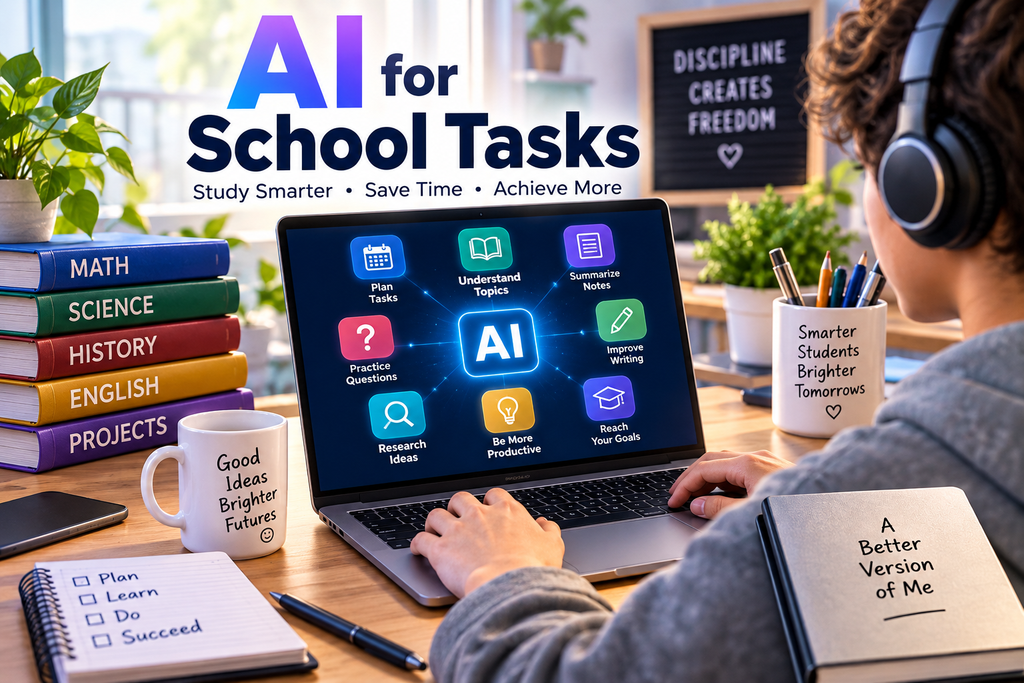
Creating a school presentation involves much more than placing information on slides. AI can help students organize their ideas, create a logical structure, suggest important points, and turn complicated information into short explanations that are easier for an audience to understand.
Students can also use AI to practice possible questions they may receive after presenting. This can improve preparation and confidence without replacing the student’s own knowledge of the subject.
- Create Flashcards for Faster Review
Flashcards are useful for reviewing vocabulary, historical dates, scientific concepts, formulas, and definitions. Instead of creating every card manually, students can provide their study notes and ask AI to transform the most important information into short questions and answers.
The cards can then be reviewed regularly before an exam. Students should remove unnecessary information and correct anything that does not match their class materials.
- Practice a New Language With AI
Learning a new language requires regular practice, and AI can give students additional opportunities to use what they learn in class. Students can practice short conversations, ask for vocabulary exercises, review grammar, or request examples of how particular words are used in everyday situations.
AI can also correct practice sentences and explain why something is incorrect. However, students should compare important grammar rules and translations with trusted educational materials, especially when preparing graded assignments.
- Break Large Assignments Into Smaller Steps
A long essay, science project, or research assignment can feel overwhelming when students look at the entire task at once. AI can help divide a large project into smaller and more manageable steps.
For example, the process might be separated into choosing a topic, researching reliable sources, creating an outline, writing a first draft, reviewing the information, and preparing the final version. Students can then establish a deadline for each step instead of trying to complete everything at the last minute.
- Get Instant Explanations When Studying Alone
Students do not always have a teacher, parent, or classmate available when a difficult question appears during study time. AI can act as an additional learning assistant by providing explanations at almost any time.
Instead of simply requesting the final answer, students can ask AI to explain each step, provide another example, or describe why a particular solution works. This encourages understanding rather than simply copying an answer.
- Build a Smarter Daily Homework Routine
AI can also help students create a consistent homework routine. By entering their subjects, assignments, deadlines, and available study time, students can organize what should be completed first and what can wait until later.
A simple daily plan can reduce forgotten assignments and last-minute work. Over time, students may also discover which subjects require more attention and adjust their study routine accordingly.
Final Thoughts: AI Should Support Learning, Not Replace It
Using AI for school tasks can make studying more organized, efficient, and manageable. From creating study schedules and practice questions to improving writing and organizing research, these tools can provide valuable support throughout the school year.
The most important rule is to use AI as an assistant rather than a replacement for thinking. Students should verify important information, follow their school’s rules regarding AI use, protect personal information, and complete assignments with their own understanding and ideas.
Used responsibly, AI can help students spend less time struggling with organization and more time developing knowledge, creativity, and independent learning skills.
How to Write Better AI Prompts for School Tasks
The quality of an AI response often depends on the quality of the instructions students provide. A very general question may produce a general answer, while a detailed request can generate information that is much more useful for studying.
For example, instead of asking, “Explain photosynthesis,” a student could ask, “Explain photosynthesis in simple language for a middle school student, give me a real-world example, and finish with three questions I can answer to check my understanding.”
Students can also tell AI which parts of a subject they already understand and which parts are confusing. This creates a more personalized learning experience and makes it easier to concentrate on areas that require additional practice.
The goal should not be to create prompts that produce completed homework. Better prompts should encourage explanations, examples, questions, comparisons, and step-by-step guidance that help students understand the material themselves.
A Simple AI Study Routine Students Can Try
Students do not need to use artificial intelligence for every school activity. A simple routine can make AI for school tasks more effective while preventing unnecessary dependence on technology.
At the beginning of a study session, students can review their assignments and decide which tasks require the most attention. AI can then help organize those tasks by priority and estimate how much study time might be necessary.
During the study session, students can use AI when they encounter a concept they cannot understand, need additional practice questions, or want to organize complicated notes. Afterward, they should try explaining the topic without AI assistance. If they can describe the concept in their own words, it is a good indication that real learning has taken place.
Important Mistakes to Avoid When Using AI for Homework
AI can save time, but using it incorrectly can create new problems. One common mistake is copying an AI-generated response without reading or understanding it. Apart from reducing the educational value of an assignment, this can introduce inaccurate information into schoolwork.
Students should also avoid entering sensitive personal information into AI tools. Names, addresses, passwords, private school information, and other confidential details should not be necessary for ordinary study assistance.
Another important consideration is school policy. Different teachers and schools may have different rules about artificial intelligence. Students should understand what type of AI assistance is permitted before using generated material in graded assignments.
Finally, AI responses should never automatically be treated as reliable sources. Important facts should be verified using textbooks, teacher-provided materials, reputable educational websites, or original sources.